
Bullet Points, Harms: What Writing a Screenplay Taught Me About the Power of Saying Less
Brevity is not an easy skill to master. As a writer, I was chastised throughout my corporate career for the sometimes overly long and needlessly wordy emails I sent.
“Bullet points, Harms,” was one of the most common reactions I would get.
The person saying it always had a smile on their face and made it seem like a joke, but it wasn’t. And they weren’t wrong.
One of the hardest skills for a writer, in certain settings, to learn is clear, concise communication. That can be a radical change for anyone who is used to writing fiction, where you get a badge of honor for taking ten pages to explain something that could have been done in one paragraph. If you don’t believe me, just go read any George R.R. Martin book and see how many pages get dedicated to describing food.
So, you might be wondering what any of this has to do with writing a screenplay.
And the answer is EVERYTHING.
A Screenplay Writing Course Begins With One Uncomfortable Rule
Before anyone embarks on the screenplay path, the first thing I want them to know is that feature screenplays generally live in the 90-to-120-page range.
Unlike business books, where you can land somewhere between 175 and 300 pages without sticking out like a sore thumb, or fiction novels that regularly exceed 500 pages, screenplays ask you to work inside a much tighter framework. One properly formatted screenplay page equals roughly one minute of screen time. It is not an exact science, but a 120-page script generally suggests something close to a two-hour movie.
Most feature scripts fall somewhere between 90 and 120 pages, although genre, story, and the people attached to a project can all affect what is considered acceptable.
That distinction matters.
This is super important to know before starting a project because there is nothing worse than making it to the end only to realize you are well over the page count and there is no way to shorten it without killing the story.
The better approach is to treat length as a design problem from the beginning, not a punishment waiting for you at the end.
Cutting What You Love Is Part of Writing the Story
What did writing an actual screenplay teach me about cutting things I wanted to keep?
It taught me that in a real-life story, nothing feels expendable.
I have been writing scripts for years, which helped me come to terms with the rules – at least for ideas of my own creation. I got a harsh reminder of how difficult this is when I worked on Cynthia’s screenplay, which I mentioned in another post. Because her story was entirely based on real-life events, there was no way to easily decide what information was not important. Everything a person has gone through, especially when it is traumatic, is important.
I knew, though, that taking that standpoint in this medium would have condemned the project before it started.
So I had to find masterful ways to combine stories, merge characters, and condense timelines. That kept the spirit of the movie intact while ensuring it was viable by industry standards.
That is the lesson the page count forces on you. In prose, you may be able to hold onto every detail because the form gives you more room. In a screenplay, the constraint pushes you to make harder decisions. Not because the material lacks value, but because the story has to move in a way the screen can sustain.
Sometimes that means cutting. Sometimes it means reshaping. And in a real-life story especially, the more honest move is often not to throw material away carelessly, but to combine, merge, and condense until the heart of the story can survive the form.

The Constraint Can Make the Screenplay Better
Did the constraints make the screenplay better rather than merely shorter?
Yes.
Constraints in screenwriting can actually improve our writing skills.
When you strip a story down to only the most essential elements and characters, you remove distraction for the viewer. The story has less room to wander, which means every scene, character, and line has to contribute to the experience in a more direct way.
There is another benefit too. Letting go of how you think the audience should view the finished product leaves room for an industry professional to elevate your work when it reaches the production stage. That can be hard for writers to accept at first, because we naturally want to control how the story lands. But screenwriting is collaborative by design, and the work usually gets stronger when you stop trying to do everyone else’s job on the page.
And then there is the professional side of it. Knowing the road to a big-screen finish will be hard-fought builds your resolve and resilience as a writer. You stop expecting the path to be easy, and that alone changes how you approach the craft.
Looking at all these constraints as a newcomer, it might feel overwhelming, and it will be unless you try. The only way to master the craft of screenplay writing is to write one. Then write another. Just like anything in life, the more you practice, the easier the process becomes. Along the way, pay attention to how you get there and how the finished result compares with what you thought had to be much longer than it was.
Know the Difference Between a Spec Script and a Shooting Script
Beyond length, the next constraint is the rules about how you can convey not only the story’s meaning but also the visuals you want a movie-goer to see.
In a spec script, detailed camera directions are generally used sparingly, and those technical decisions usually become more important once a project moves toward production. That is where a shooting script starts to operate differently.
Because of that difference, many first-time writers struggle in this space.
At face value, it seems logical that a movie writer would include camera angles. But a spec script writer’s job is not to dictate every shot. The goal is to give the director and other collaborators a strong storyline, well-defined characters, and enough visual information to bring the story to life without trying to do their jobs for them.
The only exception to these rules is if you plan to produce the movie yourself. If that is the case, you can bypass finding a producer.
And if you have tried publishing a book and thought that was hard, finding a producer is infinitely more difficult. There are fewer direct-to-audience paths for a screenplay than for a book. Self-publishing lets almost anyone make a book available to readers, but a screenplay still generally needs collaborators, financing, and production before an audience can experience it as intended, which means you may end up sitting on a vault of scripts waiting for the right opportunity.
That is a frustrating reality, and writers should understand it before they begin.
Real Paths Forward for a Finished Spec Script
That said, I do not want to leave you there, because “there is no self-publishing equivalent” is true, but it is not the whole story.
A finished screenplay does have paths forward. They are just narrower, slower, and more competitive than book publishing. That is the part people need to hear clearly. The good news is that there are still real steps you can take if your script is finished and sitting in a folder like a sealed vault.
Screenplay Contests and Competitions Can Create Discovery
For spec scripts, contests are the closest thing to a discovery platform.
Are they magic? No. Are some of them overhyped, expensive, and basically a slick way to separate hopeful writers from their entry fees? Absolutely. But the legitimate ones can still matter because they give unknown writers a way to get reads, build credibility, and create a reason for industry people to pay attention.
What does a placement or win actually do for you?
At best, it can lead to industry reads, introductions, query leverage, and a stronger answer to the question, “Why should I read your script instead of the other hundred in my inbox?” Even a semifinalist or finalist placement in a respected contest can function as social proof. It tells people your script survived some level of scrutiny.
The practical rule is simple: research every contest before you pay a dime. Look at past winners. Did anything happen for them? Are managers, producers, or agents actually paying attention to that competition? Does the contest have a long-standing reputation, or does it look like a pay-to-play machine with fancy branding and no real industry footprint?
If you cannot tell what winning is supposed to lead to, that is your answer.
Fellowships and Labs Offer Training and Access
The next route is fellowships and labs.
These programs matter because they do two jobs at once. First, they help writers develop craft inside a structured environment. Second, they can provide the one thing most emerging screenwriters do not have enough of: access.
That combination is a big deal.
A good fellowship or lab is not just a badge for your bio. It can mean mentorship, deadlines, notes, community, and sometimes direct exposure to people who can actually move a career forward. In that sense, these programs operate as both training and access, which is why they can be more valuable than a random cold submission.
If you are looking at a screenplay writing course, this is also part of what you should be thinking about. Not just, “Will this teach formatting?” but, “Will this help me understand the actual ecosystem screenwriters enter after they type FADE OUT?” Craft matters, but so does knowing where scripts go next.
Querying Managers and Agents Is a Volume Game
Another realistic path is querying managers and, in some cases, agents.
This works differently from books. In book publishing, you often pitch with a proposal, sample chapters, platform information, and a more document-heavy package. With screenplays, the pitch is leaner and the script has to start working fast. That usually means your logline needs to be sharp, your concept needs to be clear, and your first ten pages need to do real work.
Why the first ten?
Because no one is giving you much runway. A manager, assistant, or reader can tell very quickly whether the pages feel professional, whether the premise is visible, and whether the writing has control. That may sound brutal, but it is better to understand the rule than to romanticize the process.
Reasonable expectations help here. Response rates are often low. Very low. You may send many queries and hear nothing back. You may get form rejections. You may get requests months later, not days later. The timeline is not clean, and it is definitely not designed to protect your feelings.
That is not to say querying is pointless. It is just a volume game that rewards professionalism, persistence, and strong material more than wishful thinking.
Register the Script Before You Share It
Before you send the script anywhere, do one practical thing first: register it.
Register your screenplay with the WGA or the U.S. Copyright Office before you start emailing contests, managers, producers, or anyone else. Not after. Before.
Why does this matter?
Because it is the basic protection step. It creates a record of your work and gives you a stronger footing if ownership ever becomes a question. Writers sometimes treat this like an end-stage administrative chore, something to handle after the exciting part starts. That is backwards. This is the first thing to do, not the last.
It is a simple step, and skipping simple steps is how people create unnecessary risk for themselves.
Build a Body of Work, Not a Shrine to One Script
This may be the least glamorous advice in the whole article, but it is probably the most important.
Do not pin everything on one screenplay.
Most working screenwriters did not break in with the very first script they wrote. Often, the script that got attention was a later script – one written after the writer had learned more about structure, pacing, dialogue, and what the market actually responds to. The early scripts were part of the education.
That matters because a lot of writers finish one screenplay and treat it like a lottery ticket. If this one script does not sell, they stop. That is usually the wrong takeaway.
The better approach is to build a body of work. Write the next one. Then the next one. Revise the strongest one. Use contests, fellowships, and querying to create motion, but keep writing while that motion is slow. Otherwise, you end up waiting on one script to validate your identity, and that is a rough way to work.
Your Last Two Routes: Make It Yourself or Adapt It
From there, you are left with two other serious options.
The first is producing it yourself. That can mean raising money, making an indie feature, shooting a short proof of concept, or building enough traction around the material that other people can finally see what the script looks like in motion. This route can be empowering, but it is also expensive, logistically difficult, and very much a separate skill set from writing.
The second is adapting the material into another form.
And honestly, this is the route more writers should think about when a screenplay is sitting in a vault. If the story is strong but the screenplay is not finding traction, ask a simple question: is the problem the story, or is the problem the format?
Sometimes a script wants to become a novel. Sometimes it works better as memoir, nonfiction, or another kind of book. That option matters because books create different paths to audience, authority, and eventual adaptation. They also open the door to editorial guidance, coaching, and, when needed, publishing support services.
This is one of the routes PenForHire’s Movie Mastery 8-week screenplay writing course addresses in a practical way. It covers how to write a screenplay, how to adapt a book into a screenplay, and how to turn a screenplay into a book. So if your script has been sitting untouched while you try to decide whether to keep pushing, overcome writer’s block, or even hire a ghostwriter for a book version, you have more than one way to get the story in front of an audience.
That does not guarantee an easy road. Nothing in screenwriting does. But it does mean the script is not dead just because Hollywood did not kick down your door.
What Should You Look for in a Screenplay Writing Course?
A useful screenplay writing course should teach more than screenplay formatting. Formatting matters, but it is only the outer structure.
Look for a course that helps you develop a strong premise, outline a story, build characters, understand pacing, write visual action, and revise to a professional page count. You should also receive feedback on the actual pages, not only general lessons about storytelling.
Ask whether the program addresses adaptation. Can it help you turn a book into a screenplay? Can it help you take a screenplay in the other direction and develop it into a book? Does it offer accountability, coaching, or a clear schedule for completing the work?
PenForHire’s Movie Mastery 8-week screenplay writing course is designed around those practical questions. It teaches participants how to write a screenplay, adapt a book into a screenplay, or turn a screenplay into a book.
That adaptation angle matters for many of our readers. You may already have a memoir, novel, business book, or thought-leadership project sitting on your shelf. A screenplay can give that material a second life, not by copying the book page for page, but by identifying the central story, the essential characters, and the moments that can become cinematic.
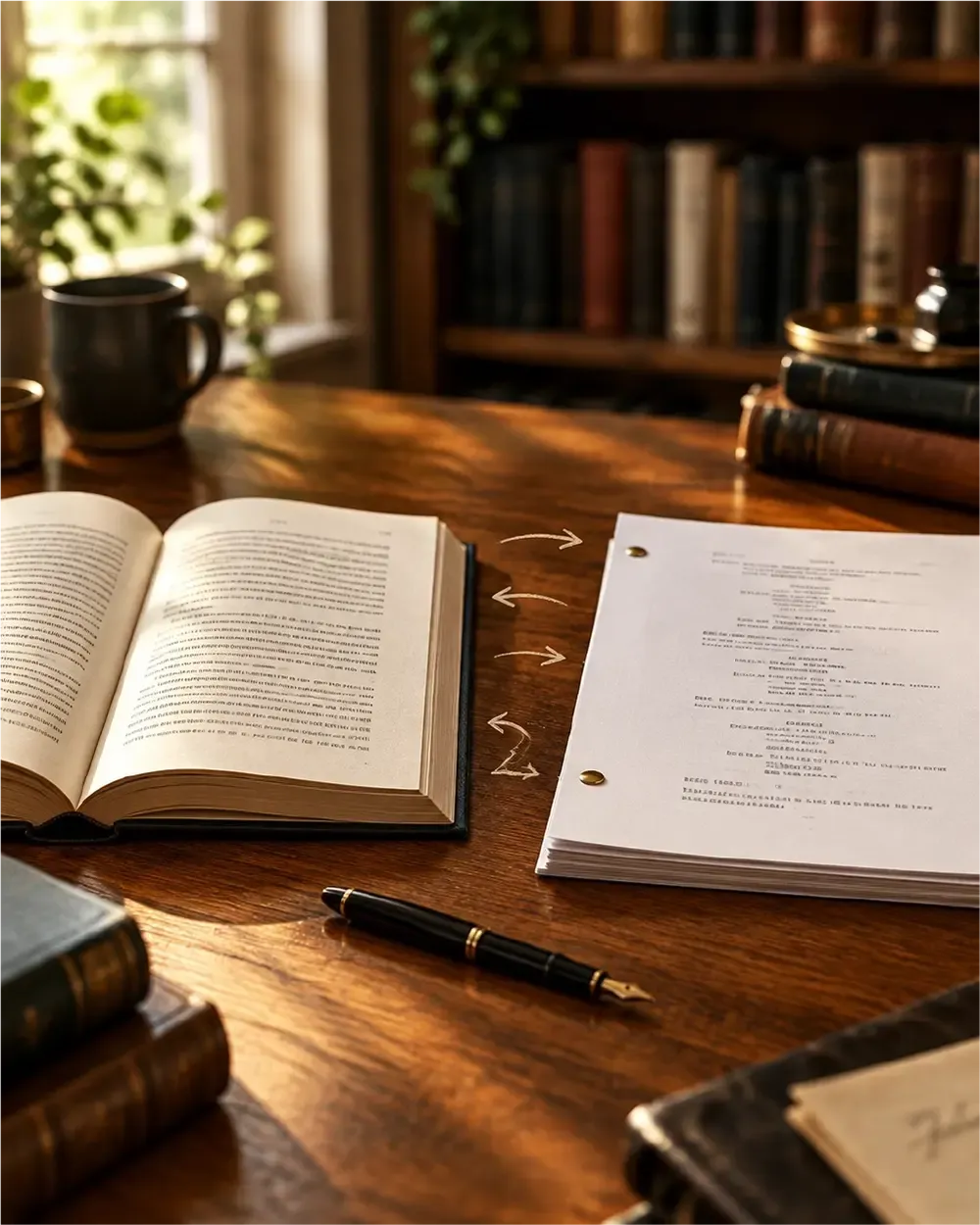
A 300-page book cannot simply be squeezed into a 120-page screenplay. Adaptation requires selection, compression, restructuring, and a willingness to let some beloved material go.
Adaptation Is Not Copying. It Is Rebuilding
When you adapt a book, ask what the audience needs to see rather than what the author originally explained.
Internal thoughts may become behavior. A long backstory may become one revealing scene. Several minor characters may become one stronger character. A subplot that worked beautifully in a novel may have to disappear because it pulls attention away from the central film.
The same discipline applies whether you are an aspiring screenwriter, a memoir author, or a coach or consultant looking to extend your message into film or television.
If you are still developing the original book, PenForHire’s free book outline tools can help you organize the story before drafting. The Write Life offers another practical entry point for writers who want guidance on how to write a book before thinking about adaptation.
And if the project is already substantial, you may benefit from a book writing coach, editor, or ghostwriting services team that can help you clarify the material before you rebuild it for the screen.
You can also leverage your book through speaking, courses, articles, consulting, and other formats. A screen adaptation is one possibility, not an automatic guarantee of production.
Brevity Is Respect, Not Just Shortness
This brings me back to “Bullet points, Harms.”
Corporate Matt thought brevity meant being terse – he heard the instruction as a demand to strip away personality, shorten every sentence, and make the email look like a collection of commands.
Screenplay writing taught me something different. Brevity is not about making the writing feel clipped. It is about respecting the reader’s time and trusting that the point matters more than the performance of writing it. A tight script and a tight email require the same discipline: decide what matters, present it clearly, and stop before the audience starts looking for the exit. That does not mean every sentence should be plain or every scene should be rushed. It means every choice should have a reason.
The same lesson applies when you are trying to overcome writer’s block, evaluating whether to hire a ghostwriter, or deciding whether you need help hiring a ghostwriter. More words do not automatically create more value. Sometimes they only create more places for the reader to get lost.
That is also why a polished book matters when you want to build your brand with a book. Readers notice when a project has been shaped with care, and when it has not. They also notice when a writer understands that AI will not replace writers but that adapting to AI still requires judgment, editing, and a clear human voice.
So, yes, “Bullet points, Harms” was good advice. I just needed a screenplay to understand why.
It is ironic to think about all the times I was told “Bullet points, Harms,” when I wanted to push back and argue how important every word I wrote was – and now I realize that sometimes the most important words are the ones we never include.
If you have a screenplay, book, memoir, or adaptation idea, do not wait until the project becomes unmanageably long to ask for help. Book a discovery consultation with PenForHire before you begin. We can help you determine what the project needs, whether that means coaching, outlining, editing, ghostwriting, screenplay development, or publishing support.
Start with the story. Then earn every page.

Related Posts

How to Use Your Book to Acquire 2-3 High Ticket Clients Every Month

Lessons from 60+ Books: You Don’t Need Time to Write a Book, You Need 30 Minutes (and How to Write a Book Anyway)
